

We may earn money or products from the companies mentioned in this post.
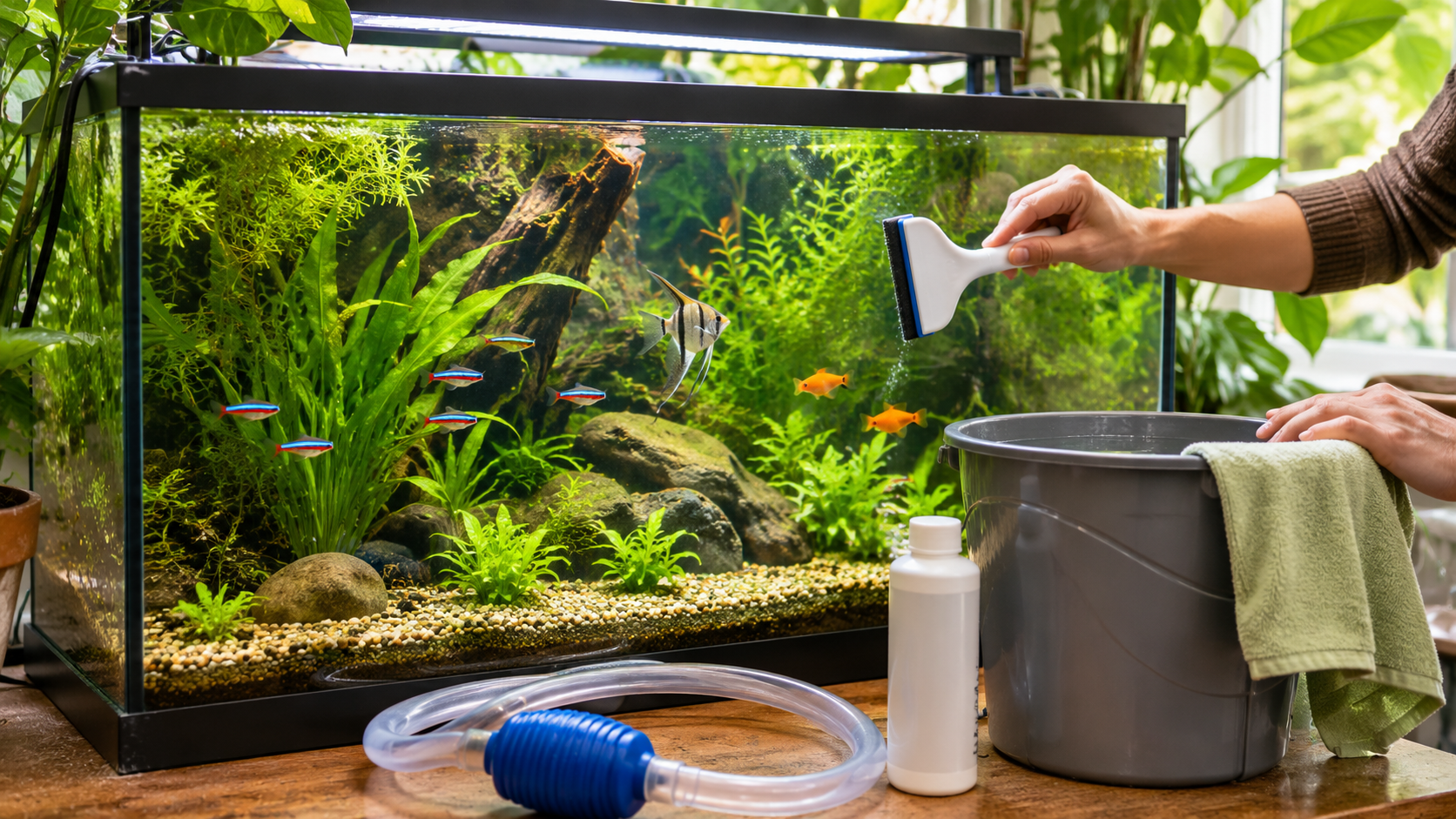
Cleaning a freshwater aquarium is about maintaining healthy water without disrupting the beneficial microorganisms that process fish waste. You don’t need to make every surface spotless. A consistent, gentle routine is safer and easier than occasional aggressive deep cleaning.
This beginner-friendly guide explains how to clean a freshwater aquarium, protect its nitrogen cycle, maintain the filter, and recognize when routine cleaning isn’t enough.
Understand the nitrogen cycle before you clean
Fish waste, uneaten food, and decomposing material release ammonia. Beneficial microorganisms convert ammonia into nitrite and then nitrate. Both ammonia and nitrite can harm fish; nitrate is generally less toxic but still needs monitoring. Ammonia toxicity is influenced by pH and temperature. Some Nitrospira microorganisms can complete the conversion from ammonia to nitrate, a process called comammox.
These microorganisms grow attached to surfaces, especially filter media, but also gravel, decorations, and plants. Most aren’t floating freely in the water. Preserve established biological filter media and avoid unnecessary deep cleaning.
How often should you clean a freshwater aquarium?
If you’re learning how to clean a freshwater aquarium, start with water testing and a manageable routine rather than a complete teardown.
For many established community tanks, a weekly 10–25% partial water change is a reasonable starting point, not a universal rule. The right schedule depends on stocking, feeding, plants, filtration, and test results. Many aquarists aim for nitrate below roughly 20–40 ppm, with lower levels appropriate for some sensitive species. Test your particular aquarium and adjust accordingly.
| Task | Starting frequency |
|---|---|
| Partial water change | Weekly, about 10–25% |
| Light gravel vacuuming | During water changes |
| Glass algae removal | As needed |
| Ammonia, nitrite, nitrate testing | Weekly, more often if unstable |
| Filter cleaning | When debris restricts flow |
| Plant trimming | As needed |
Supplies for safe aquarium cleaning
- A bucket used only for aquarium maintenance
- A gravel vacuum or siphon
- Water conditioner effective against chlorine and chloramine
- An aquarium-safe algae scraper (acrylic-safe for acrylic tanks)
- Water test kit and thermometer
- Soft aquarium-only brush
Never use soap, detergent, or household cleaning sprays on aquarium equipment.
How to clean a freshwater aquarium step by step
Step 1: Prepare and check the equipment
Gather your supplies and test the water if you’re investigating a problem. If the water level will drop below the heater’s safe operating level, switch it off and allow it to cool according to the manufacturer’s directions. Most fish can remain in the aquarium during routine maintenance.
Step 2: Clean the glass and trim plants
Use an aquarium-safe scraper to remove algae. Keep trapped gravel away from the scraper to avoid scratches. Trim dead or decaying plant leaves without disturbing healthy roots unnecessarily.
Step 3: Gently vacuum the substrate
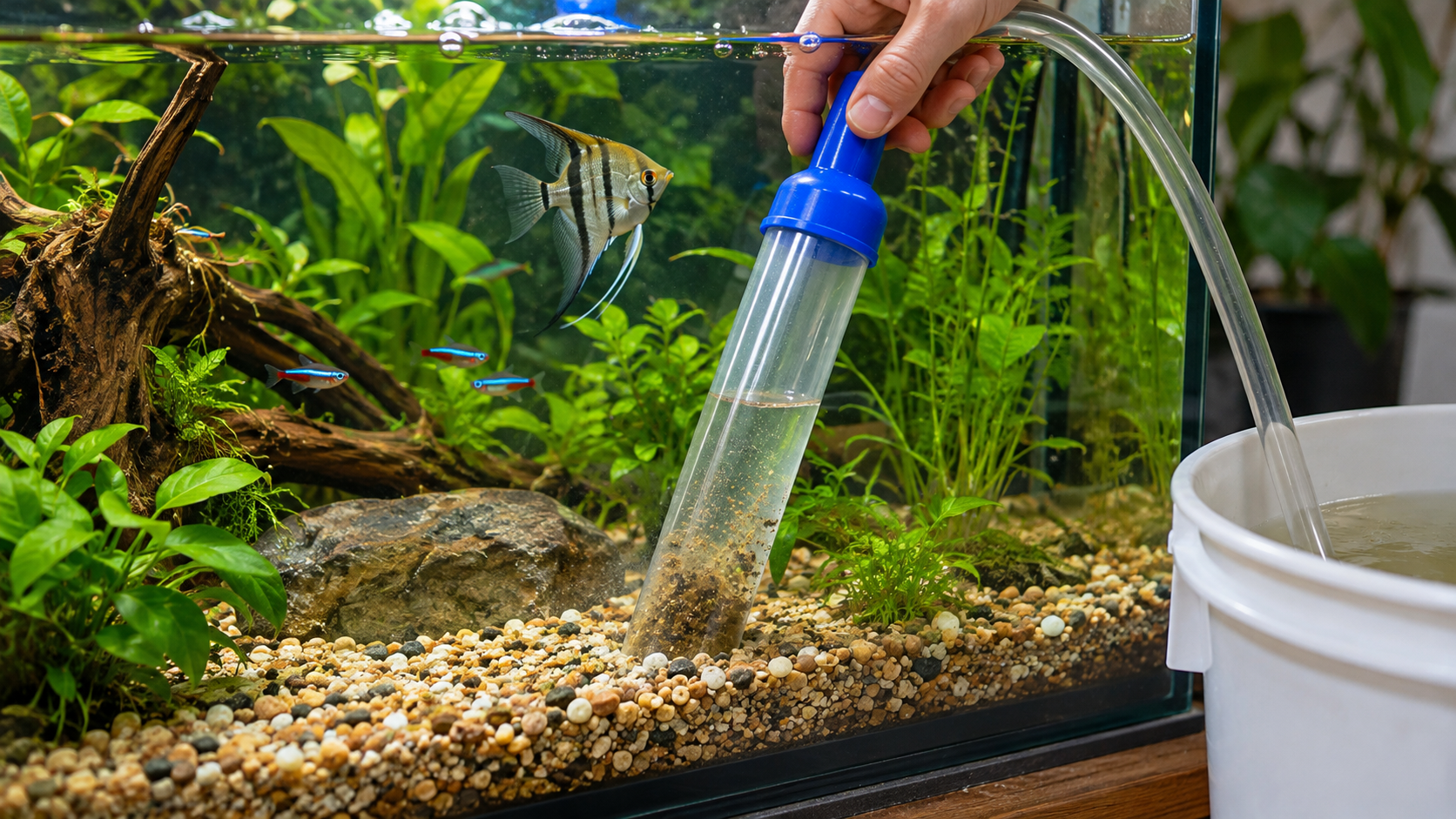
For gravel, lower the siphon into selected areas so waste rises while gravel falls back. Rotate cleaning areas between sessions. For sand, hover the siphon just above the surface. Work carefully around plant roots and small fish or shrimp.
Step 4: Remove part of the water
During vacuuming, remove approximately 10–25% of the aquarium water as a starting point. In a 20-gallon aquarium, that is about 2–5 gallons. Adjust based on test results and the tank’s needs.
Routine cleaning versus emergency water changes
Routine partial water changes remove accumulated waste and support stable conditions. But if ammonia or nitrite reaches unsafe levels, larger or more frequent water changes may be necessary to protect fish. Use conditioned replacement water, match temperature and relevant water chemistry, and continue testing until conditions stabilize.
Don’t delay a needed emergency water change out of fear of removing beneficial bacteria: most nitrifying microorganisms are attached to filter media and other surfaces, not suspended in the water. Routine 100% changes are rarely necessary and increase the risk of abrupt temperature or chemistry changes, although large changes can be appropriate in emergencies.
Step 5: Condition and add replacement water
For background on public drinking-water systems and treatment, see the U.S. Environmental Protection Agency’s drinking water resources.
Tap water may contain chlorine or chloramine. Chlorine may dissipate over time, but chloramine is more persistent, so use an aquarium conditioner that treats both. If conditioning water in a bucket, dose for the bucket’s volume. If adding conditioner directly to the aquarium, follow that product’s in-tank directions; some require dosing for the full aquarium volume.
Match replacement-water temperature and consider pH and hardness differences, especially for sensitive species. Add water slowly to avoid disturbing substrate.
Step 6: Restart and observe
Check that the heater and filter are operating properly. Watch fish for unusual swimming, gasping, or lethargy. If anything seems wrong, promptly test ammonia, nitrite, temperature, and pH and check whether the water was conditioned correctly.
How to clean filter media without losing beneficial bacteria
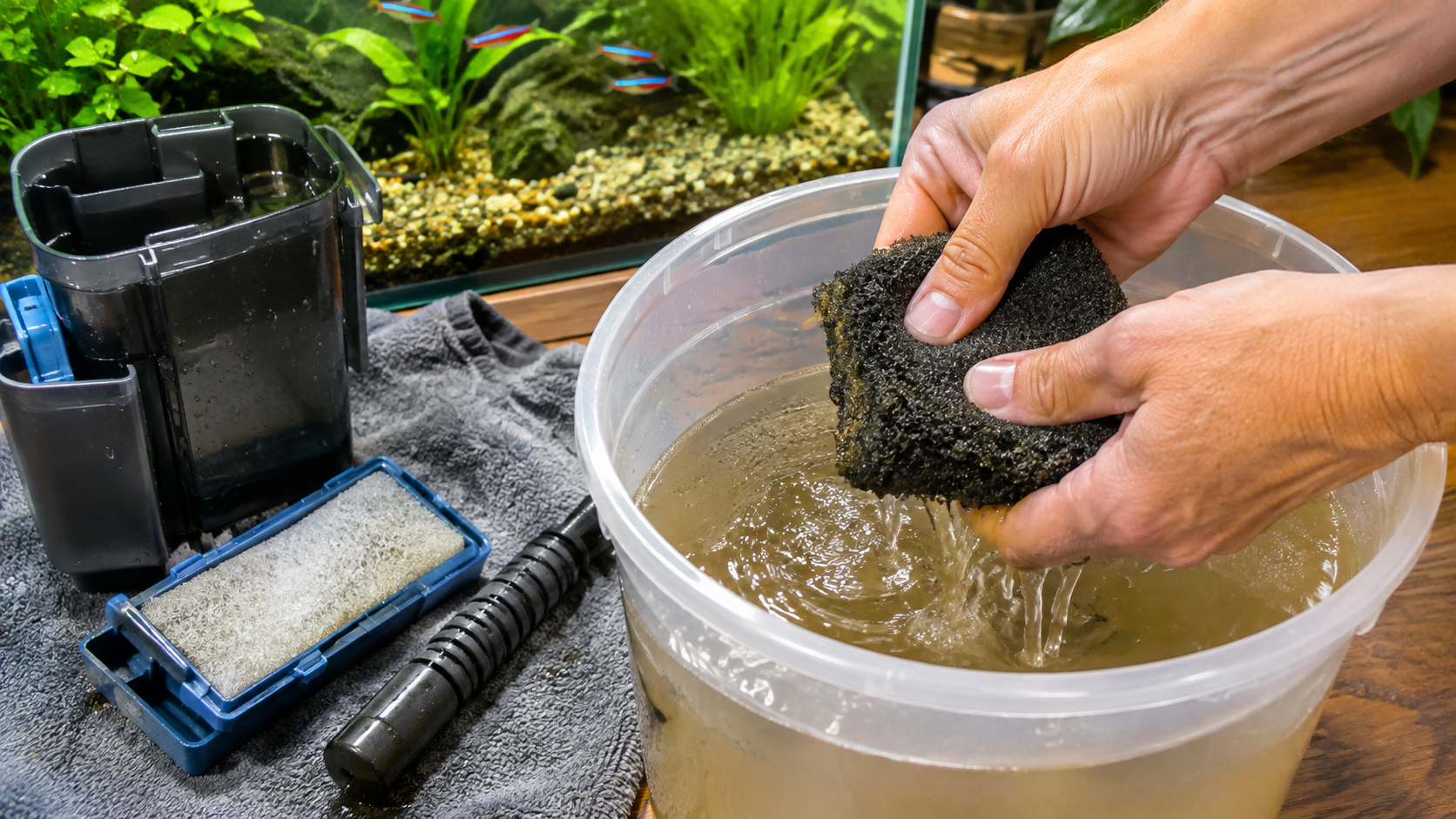
Clean the filter when accumulated debris noticeably reduces flow, rather than replacing biological media on an arbitrary calendar. Gently swish or squeeze reusable sponge or biological media in removed tank water or properly dechlorinated water. Remove enough debris to restore flow without aggressively stripping away biofilm.
A brief rinse in untreated tap water doesn’t automatically destroy all bacteria, but disinfectants can harm them, so avoid it when possible. Keep media moist during maintenance. Clean mechanical components, intake screens, and impellers as needed, following manufacturer instructions.
Replacing all established cartridges at once can reduce biological filtration. If replacement is necessary, retain some established media alongside new media temporarily when the filter design allows.
Controlling algae without overcleaning
Some algae is normal. Brown diatoms are common in new aquariums; cyanobacteria, often called blue-green algae, are bacteria rather than true algae. Black beard algae is often associated by hobbyists with fluctuating carbon dioxide or other imbalances, although no single cause is firmly established.
A consistent light schedule, appropriate feeding, live plants, manual removal, and regular maintenance can help. Six to eight hours of light daily is a common starting point, adjusted to plant needs. Snails can graze on some algae, but don’t replace maintenance. Learn more in our freshwater aquarium snails guide.
Cleaning decorations and avoiding contamination
Decorations usually need only occasional gentle brushing in removed aquarium water or conditioned water. Avoid soap and routine chemical cleaning, particularly for porous rocks and wood. Don’t share tools between a sick tank and a healthy tank without appropriate disinfection, or use dedicated equipment.
Common aquarium cleaning mistakes
- Cleaning everything at once: Aggressive substrate cleaning plus replacing all filter media can disrupt biological filtration.
- Using untreated tap water: Always address chlorine and chloramine.
- Changing water without matching conditions: Sudden differences in temperature or chemistry can stress fish.
- Overfeeding: Leftover food adds waste and can increase algae growth.
- Assuming clear water is safe: Ammonia and nitrite may be present even in clear water.
Troubleshooting after cleaning
Cloudy water
Cloudiness can come from disturbed substrate, suspended debris, or a microbial bloom. Don’t assume it is harmless: test ammonia and nitrite, check filtration, and watch fish closely.
Ammonia or nitrite spikes
Test promptly, perform appropriately sized conditioned water changes if needed, reduce unnecessary feeding, and investigate disrupted filtration or excess waste. Most hobby ammonia tests measure total ammonia (ammonia plus ammonium); pH and temperature influence how much is present in the more toxic form. Keep testing until conditions stabilize.
Rapid algae regrowth
Review lighting, feeding, nutrients, stocking, and maintenance instead of only scraping visible algae.
Fish behaving unusually
Check temperature, ammonia, nitrite, pH, and water-conditioning steps immediately. Gasping, loss of balance, or severe lethargy warrants prompt action.
Unpleasant odors or weak filter flow
Remove decaying food or plant matter and check for blockages in the intake, impeller, and mechanical media. Preserve established biological media while restoring flow.
Special cases: new, planted, and shrimp aquariums
New tanks: Test ammonia and nitrite frequently. Fish-in cycling may require prompt water changes to protect fish. Fishless cycling follows a different maintenance approach.
Planted tanks: Vacuum gently around roots; plants absorb nutrients but do not eliminate all maintenance needs.
Shrimp tanks: Protect small invertebrates from siphons and avoid abrupt changes in temperature, hardness, or pH.
Medicated tanks: Follow medication directions. Activated carbon can remove some medications; avoid sharing contaminated equipment.
Simple freshwater aquarium maintenance checklist
Daily
- Observe fish behavior and appetite.
- Check heater and filter operation.
- Remove obvious uneaten food if necessary.
Weekly
- Test water parameters.
- Change an appropriate portion of water.
- Vacuum accumulated debris and clean visible algae.
- Trim decaying plant leaves and inspect equipment.
As needed
- Rinse clogged filter media gently.
- Clean intakes and impellers.
- Adjust maintenance if water tests or algae growth indicate a problem.
Frequently asked questions
Can fish stay in the tank during cleaning?
Yes, usually. Routine maintenance is generally less stressful when fish remain in place. Work carefully around them.
How often should I vacuum gravel?
Lightly vacuum during regular water changes, focusing on debris buildup rather than deep-cleaning every section each time.
Can I rinse a filter sponge?
Yes. Rinse reusable media gently in removed aquarium water or dechlorinated water when flow becomes restricted.
Does a water change remove the beneficial bacteria?
Not most of them. The important nitrifying communities are primarily attached to filter media and other surfaces.
Do I need activated carbon?
Not for biological filtration in every aquarium. It can remove certain dissolved substances and medications, but doesn’t replace water changes.
Final thoughts
Good freshwater aquarium cleaning is consistent, gentle, and guided by water tests. Preserve biological filter media, remove accumulated waste, treat replacement water properly, and distinguish routine maintenance from water-quality emergencies.
If you’re planning your first setup, see our freshwater aquarium starter kit comparison and our guide to peaceful freshwater community fish.
Pingback: Fluval Vista 16-Gallon Aquarium Kit: Specs, Setup Costs & Buying Guide - Fishkeeping Made Clear