

We may earn money or products from the companies mentioned in this post.
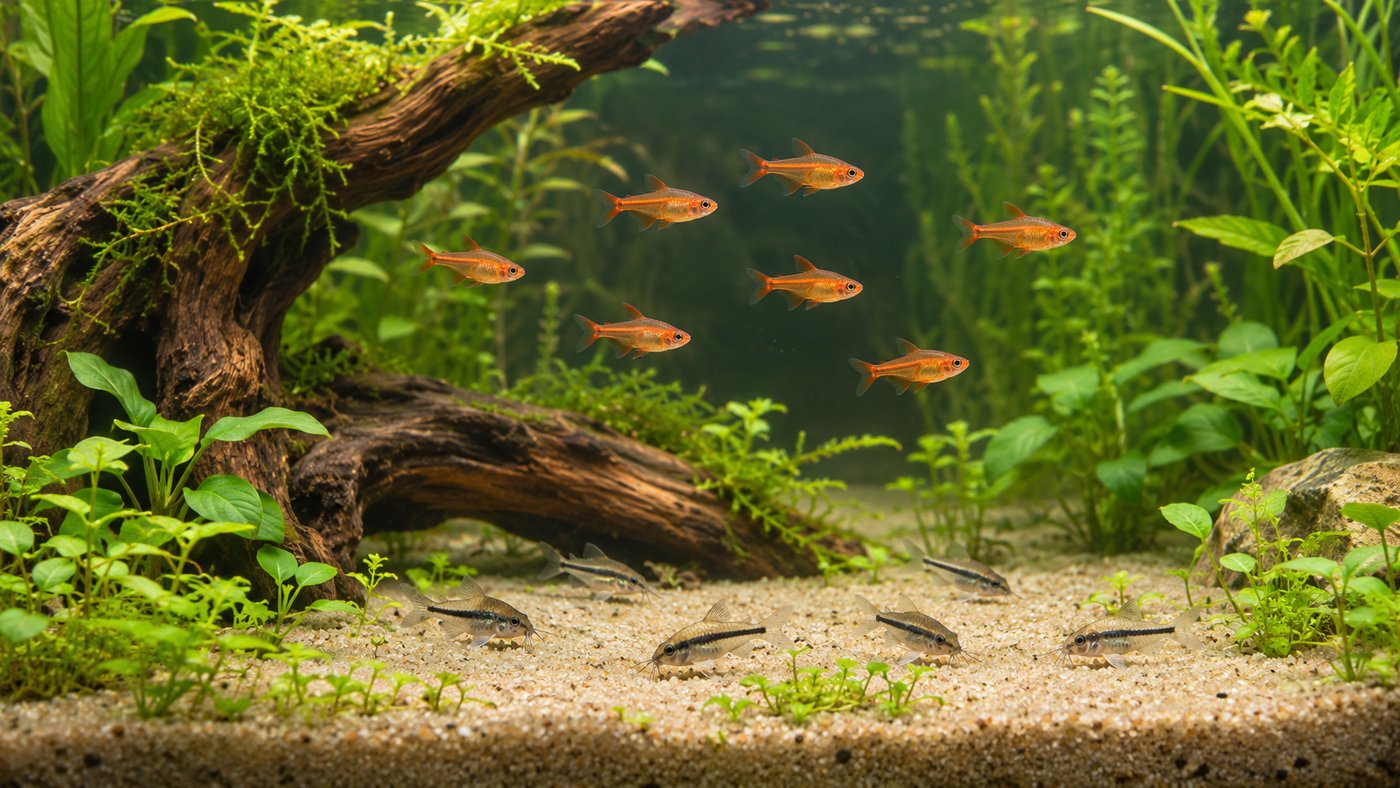
- Key takeaway: Freshwater community fish compatibility depends on five factors working together: adult size, tank space, water chemistry, temperament, and social needs like schooling.
- A fish’s size at the pet store may be much smaller than its adult size, so always research full-grown dimensions before adding it to a mixed tank.
- Fish from the same region are not automatically compatible, and fish from different regions can live together when their care requirements and behavior are compatible.
- Fishkeeping Made Clear breaks down how to match species by behavior and water needs rather than guesswork, which you’ll see throughout this guide.
- Stick around for a compatibility checklist you can use before buying a single fish.
A peaceful community tank doesn’t happen by accident. It happens because someone did their homework before adding fish to the aquarium.
Introduction: Planning a peaceful freshwater community tank
Walk into any fish store and it’s tempting to pick out whatever looks colorful or interesting that day. But freshwater community fish compatibility isn’t about picking pretty fish and hoping for the best. It’s about understanding how different species interact, what they need to thrive, and whether your tank can actually support them together.
The guidance in this article points back to one idea: successful community tanks are planned, not improvised. That planning starts long before you bring home a single fish, and it continues as your fish grow and your tank matures.
Quick answer: What makes community fish compatible?
Compatible community fish share similar water requirements, won’t outgrow each other into predator-and-prey situations, and have temperaments that don’t clash. Size, tank space, water quality, behavior, and social needs all factor into whether a group of fish will actually get along long-term, not just on the day you bring them home.
Adult fish size, tank dimensions, and swimming space
Size is one of the biggest factors in fish compatibility, and it’s also one of the easiest to get wrong. A fish that looks small and harmless in a store tank can grow substantially as it matures.
The One-Inch-Per-Gallon Rule and Why It Falls Short
You may have heard that one inch of adult fish per gallon of water is a safe stocking guideline. It isn’t a reliable way to decide how many fish your aquarium can support because it doesn’t account for body shape, activity, social needs, or waste production. A stocky fish and a slender fish of the same length can place very different demands on an aquarium. Territorial fish also need room to establish boundaries, since they’re defending space, not just occupying it.
How Tank Shape Affects Fish Behavior
Tank shape matters alongside volume. Longer aquariums give active swimmers like danios and barbs more horizontal swimming room and space to avoid constant run-ins with tankmates. Tall, narrow tanks don’t offer the same swimming space. Deep-bodied fish such as discus and angelfish need sufficient height, but they also need adequate length, width, and overall space; a tall tank alone does not make an aquarium suitable.
Compare New Fish With the Adult Size of Your Current Stock
When you add new fish to an established tank, compare their current and eventual adult sizes with what’s already swimming there. This matters even more with predatory or territorial species. Similar size can reduce some risks, but it doesn’t guarantee compatibility, and choosing a larger newcomer is not a reliable solution to aggression.
Juvenile fish may behave differently from adults, including species that become territorial as they mature. That’s why relying on a fish’s current behavior in the store tank can be misleading. For more insights on choosing the right fish, explore this fish compatibility guide.
Why Today’s Tiny Fish Won’t Stay Tiny
Many fish sold in stores are juveniles that still have substantial growing to do. A species that seems peaceful and small today might become territorial as it matures, which can make it a poor long-term choice for a particular community setup. Before buying, it’s worth asking a simple question: what does this fish look like, and how does it behave, once it’s fully grown? Skipping this step can lead to compatibility problems months after setup.
Matching temperature, pH, and water hardness requirements
Even if two fish are perfectly matched in size and temperament, they still won’t thrive together if their water needs are completely different. Water chemistry compatibility is just as important as physical compatibility, and it’s often overlooked by beginners eager to stock a new tank.
Research a Species’ Natural Habitat Before You Buy
Every species comes from a particular range of environments, whether that’s a slow-moving blackwater river, a fast-flowing stream, or a mineral-rich lake. Before adding a fish to your stocking list, look into its natural habitat, recommended temperature, preferred water hardness, and any specific care needs. This step helps prevent avoidable stress and health issues down the road.
Check Compatibility Even When Fish Come From the Same Region
Fish from the same region don’t necessarily share the same water requirements or temperament. Likewise, coming from different continents does not automatically make two species incompatible. A geographically themed aquarium can be an appealing choice, but compare each species’ actual needs and behavior rather than using its place of origin as a compatibility rule.
How Poor Water Conditions Affect Fish Health and Behavior
Mismatched water parameters can stress fish, while poor water quality can damage their health. Neither issue guarantees aggression, but both can undermine an otherwise suitable community. Before finalizing your stocking list, run through these basics:
- Confirm the temperature range each species needs and make sure they overlap.
- Check pH requirements separately from hardness; these measurements are related but are not interchangeable.
- Research water hardness requirements, especially for species with more specific needs.
- Avoid overcrowding, since competition for space and food increases stress even among otherwise compatible species.
Getting water chemistry right isn’t glamorous, but it’s the foundation everything else is built on. Skip this step, and even the most carefully chosen fish combination can run into trouble.
Temperament, territory, fin-nipping, and predation
Water chemistry and size are essential checks, but temperament also helps determine whether fish will actually get along once they’re together. This is where a lot of well-researched stocking plans still go wrong.
Spotting Aggressive Species Before You Bring Them Home
Some species are unsuitable for a typical peaceful community aquarium, but broad labels such as cichlid, loach, or catfish don’t tell you enough. These groups include fish with very different behavior and care requirements.
Certain freshwater fish sold as “sharks,” along with some cichlids, loaches, knifefish, and mormyrids, can be territorial or need specialized companions. Predatory species also occur among catfish, halfbeaks, leaf fish, needlefish, bichirs, gobies, arowanas, stingrays, and gar. Some predatory catfish hunt at night and may eat smaller sleeping tankmates. Research the exact species rather than assuming every member of a group behaves alike.
Why Some Male Cichlids Fight for Dominance
Male fish of some territorial species can become more aggressive around mating. Keeping multiple males of the same or closely related species can create conflict, especially when females are present, but the risk depends on the species and setup.
Some cichlid communities develop clear pecking orders, and smaller or submissive fish can end up harassed badly enough that they need to be removed. Removing the aggressor doesn’t always solve things either, since another fish may assume the dominant role.
The “If It Fits in the Mouth” Rule
Here’s a useful warning: if a fish can fit into another fish’s mouth, predation may be a risk. This isn’t about one species being “evil,” it’s about feeding behavior. A guppy that looks safe next to a juvenile oscar can become prey as that oscar grows.
This is why checking adult size against mouth size matters as much as checking temperament descriptions. A fish labeled “peaceful” can still eat a smaller tankmate if given the opportunity and the right size difference.
Using Rocks, Wood, and Plants to Break Sightlines
Decorations do more than make a tank look nice. For territorial fish, rocks and driftwood can help define boundaries instead of leaving the entire aquarium as one open area. Tall, bushy plants provide cover for fish such as tetras, barbs, danios, and rasboras. Breaking sightlines can reduce some encounters, although it won’t make fundamentally incompatible fish safe to keep together.
How Breeding Pairs Turn Territorial
Fish that guard eggs or fry may become more defensive once breeding starts. A previously calm pair can claim a section of the tank and drive other fish away. If you notice this happening, have a suitable separation option available so you can protect the fish involved.
Livebearers come with their own version of this issue. In commonly kept species such as guppies and platies, males may pursue females persistently. Keeping more females than males—often two to three females per male—can help spread out that attention, although the appropriate arrangement depends on the species and available space.
Schooling needs, group sizes, and swimming zones
Not every compatibility issue comes from aggression. Sometimes a fish struggles because its social needs aren’t being met, which can happen when shoaling species are kept alone or in groups that are too small.
Why Shoaling Fish Need Suitable Groups
Many danios, tetras, rainbowfish, rasboras, and catfish are shoaling fish, meaning they benefit from the security of their own species. Six is a commonly suggested starting group size for many aquarium species, but it isn’t a universal number: some need larger groups. A group means members of the same species, not six unrelated fish. The RSPCA’s guidance on keeping fish together explains the importance of researching each species’ needs.
Shy schooling species may become more confident in suitable groups. Even boisterous species like tiger barbs can behave better in larger groups than in groups of two or three, although this doesn’t eliminate fin-nipping or make them suitable companions for every fish.
Stocking the Top, Middle, and Bottom of the Tank
A well-planned community tank considers the whole water column, not just the middle. Choosing fish with different depth preferences can reduce competition for particular areas, but it doesn’t increase the aquarium’s overall capacity. Surface dwellers, midwater swimmers, and bottom dwellers still share the same water and filtration.
Many Corydoras species are peaceful bottom-dwelling fish that forage in the substrate. Otocinclus graze algae and biofilm on plants, glass, and other surfaces throughout the aquarium rather than staying exclusively on the bottom. They generally do best in established tanks with suitable food available.
Schooling Fish Options for Community Aquariums
Some species are commonly considered for peaceful community aquariums when their particular requirements are met. These include:
- Rummynose Tetras
- Cherry Barbs
- Harlequin Rasboras
- Zebra Danios
- Congo Tetras
- Glowlight Tetras
- Bloodfin Tetras
- Pygmy Corydoras
- Cardinal Tetras
- White Cloud Minnows
These are options for different setups, not a list of fish that should all live together. Their adult sizes, activity levels, temperature requirements, and space needs vary.
Research the group size recommended for each species and make sure the aquarium can accommodate that group comfortably.
Fish combination examples, with species-specific requirements and limitations
Theory is useful, but seeing how these rules play out in an actual tank setup makes everything click. Tank size has a direct impact on which combinations are realistic, so let’s look at two common starting points.
A Sample Stocking Plan for a 10-Gallon Tank
A 10-gallon tank does not have a universal capacity of six to eight slim-bodied fish. The exact species, adult size, swimming needs, filtration, and maintenance all matter.
One modest option for a suitably maintained, cycled 10-gallon aquarium is a group of six to eight ember tetras. This is a small-species example, not a rule that applies to all tetras or other slender fish. A single male betta is another possible option, rather than an automatic addition to that group.
Combining fish that use different swimming levels still requires care in a tank this small. Don’t add bottom dwellers or a centerpiece fish simply because an area looks empty; their social needs and total space requirements must also fit.
A Sample Stocking Plan for a 20-Gallon Tank
Stepping up to a 20-gallon tank offers more flexibility, particularly with a long footprint. However, it does not automatically provide enough room for larger species such as snakeskin gouramis, giant danios, Congo tetras, or scissortail rasboras. “Rainbowfish” also covers species with widely different adult sizes and housing needs.
A cautious starting point is a suitable group of a small schooling species, such as ember tetras, with any additional species assessed against the tank’s dimensions, water conditions, and remaining capacity.
- Giant danios and Congo tetras need more swimming space than a standard 20-gallon aquarium provides.
- Rainbowfish must be identified by species before their group and space requirements can be assessed.
- Scissortail rasboras should not be treated as default choices for a 20-gallon community.
For perspective, Seriously Fish recommends a base measuring approximately 48 by 18 inches for the giant danio species Devario malabaricus, while Fluval lists 40 US gallons for Congo tetras.
Stocking plans aren’t rigid formulas, but they can be a useful starting point when the exact species and aquarium dimensions are considered together.
Why Goldfish Don’t Follow Tropical Fish Rules
Goldfish are a category of their own. They can be kept alone, but that does not remove the need to meet their space, environmental, and behavioral requirements. Their substantial adult size and waste output, along with temperature needs that differ from many tropical species, make them unsuitable as casual additions to a tropical community.
Avoid Mixing Single-Tail and Fancy Twin-Tail Goldfish
Even within the goldfish world, compatibility matters. Fast-swimming single-tailed varieties are generally best kept apart from slower fancy varieties. The slower fish can struggle to compete for food, so swimming ability and access to feeding should guide the choice of companions.
The One Male Betta Per Tank Rule
Male bettas should not be housed together in the same undivided aquarium because they can seriously injure one another. Some individual bettas can live in carefully planned community tanks, but others cannot tolerate tankmates.
When choosing tankmates for a betta, fin-nipping species should be avoided, since long, flowing betta fins make an easy target. Space, temperature, activity levels, and the betta’s individual behavior also matter.
Quarantine and gradual stocking
Even a carefully planned stocking list can run into trouble if fish are introduced without accounting for disease risk or the aquarium’s biological filtration. Careful introduction matters just as much as the planning that came before it.
Why New Fish Need Quarantine First
Bringing new fish straight from the store into your main tank skips a step that helps protect everyone already living there. New fish can carry parasites or illnesses that aren’t visible yet, and quarantine provides time to observe them before introduction.
A separate, appropriately sized aquarium can serve this purpose, but it still needs suitable temperature, oxygenation, cover, and water quality. A sponge filter must be biologically established or supported by careful testing and water management; simply adding a new filter does not make a tank cycled. See the guidance on quarantine setup and disease prevention.
Quarantine also gives new arrivals time to settle and begin eating normally before facing a new social environment. It does not necessarily mean keeping each fish alone; compatible fish acquired together can be quarantined as a group.
This step applies to peaceful fish as well as territorial or semi-aggressive species. Before moving any fish into the main tank, confirm a few basics during quarantine:
- The fish are eating consistently and showing normal behavior.
- There are no visible signs of illness, such as new spots, lesions, or abnormal breathing, while recognizing that appearance alone cannot rule out infection.
- Temperature and water chemistry are suitable, with any differences managed through appropriate acclimation.
Adding Fish in Suitable Groups, Not All at Once
Once fish clear quarantine, plan additions around the aquarium’s biological capacity as well as its social dynamics. Adding too much livestock at once can increase waste faster than the filter can process it, so monitor ammonia and nitrite and allow the system to stabilize before further additions.
For shoaling species, balance gradual stocking with the need for an appropriate social group rather than introducing individuals one at a time and leaving them isolated.
Signs of Bullying to Watch For After Introduction
After adding new fish, keep an eye out for torn fins, fish hiding constantly, or one fish chasing another away from food repeatedly. These can be warning signs that the social dynamic isn’t working, although injury and hiding can also have other causes. Fish have individual personalities, and even species considered generally peaceful can behave unpredictably, so don’t assume a stocking list that works on paper will automatically work in your specific tank.
If bullying continues despite adjustments to decorations or tank arrangement, be prepared to separate the fish involved. Sometimes compatibility simply comes down to individual fish that don’t get along, regardless of species reputation.
Before-you-buy compatibility checklist
Running through a short checklist before any purchase saves a lot of headaches later. Here’s what’s worth confirming before a new fish comes home.
1. Confirm the Fish’s Adult Size Against Your Tank
Look up the fish’s full-grown size, not its current size in the store tank, and compare its space requirements honestly against your tank’s dimensions and existing stock.
2. Match Temperature, pH, and Hardness Needs
Check that the new species’ recommended water conditions overlap with what’s already established in your tank. A fish that requires soft, acidic water may be unsuitable for a tank maintained in hard, alkaline conditions, even if the temperature matches.
This step is easy to skip when a fish looks appealing, but unsuitable water conditions can cause ongoing stress and health problems.
3. Check Temperament and Territorial Habits
Research whether the species is known for aggression, fin-nipping, or territorial behavior, and consider whether that fits with what’s already in your tank.
4. Plan for Proper Schooling Numbers
If the fish is a shoaling species, plan for the recommended number of its own species rather than buying one or two. Six is a common starting point for many species, but some need more, and your tank must have room for the appropriate group.
5. Ask Your Fish Retailer the Right Questions
Ask your fish retailer about the exact species, adult size, temperament, and any special requirements. Cross-check that advice with reputable species-specific care information, and don’t hesitate to walk away from a purchase if the answers don’t line up with your current tank setup.
Taking five extra minutes at the store to ask these questions is far easier than rehoming a fish months later because it outgrew its welcome.
Conclusion: Plan your community before purchasing fish
Freshwater community fish compatibility comes down to matching size, water chemistry, temperament, and social needs before any fish enters your tank, not after. The species that thrive together share more than just a tank: they have compatible needs and behavior that remain manageable as every fish grows and matures.
A little research before each purchase pays off for years of calmer, healthier fishkeeping, and it helps create a community tank that works long-term.
Frequently Asked Questions
Can I mix fish from different continents in one tank?
Yes, provided their temperature, pH, hardness, space, size, and behavioral needs are compatible. Coming from different continents does not automatically make fish unsuitable companions.
Likewise, fish from the same region are not automatically compatible. Assess the exact species and your aquarium’s conditions rather than relying on geography.
How many fish can I safely add to my tank at once?
There’s no fixed number that works for every tank. It depends on the species, their size and social needs, your current stocking level, and the biological filter’s capacity to process additional waste.
Plan additions in suitable groups, monitor ammonia and nitrite, and wait until water quality remains stable before adding more fish. Gradual stocking should not leave shoaling fish without an appropriate group.
What should I do if two fish in my tank start fighting?
Rearranging decorations can sometimes help by breaking up sightlines and disrupting established territories. If a fish is being injured, relentlessly chased, or prevented from feeding, separate the fish promptly using suitable housing rather than waiting for the conflict to resolve itself.
Watch closely after making changes, since removing an aggressor doesn’t always solve the issue. Sometimes another fish assumes the dominant role, and the remaining combination needs reassessment.
For more guidance on building a thriving, well-matched freshwater tank, Fishkeeping Made Clear breaks down fish compatibility topics like this one in plain, practical terms.
Pingback: How to Clean a Freshwater Aquarium Without Disrupting Its Cycle - Fishkeeping Made Clear
Pingback: Fluval Vista 16: Specs, Setup Costs & Buying Guide