

We may earn money or products from the companies mentioned in this post.
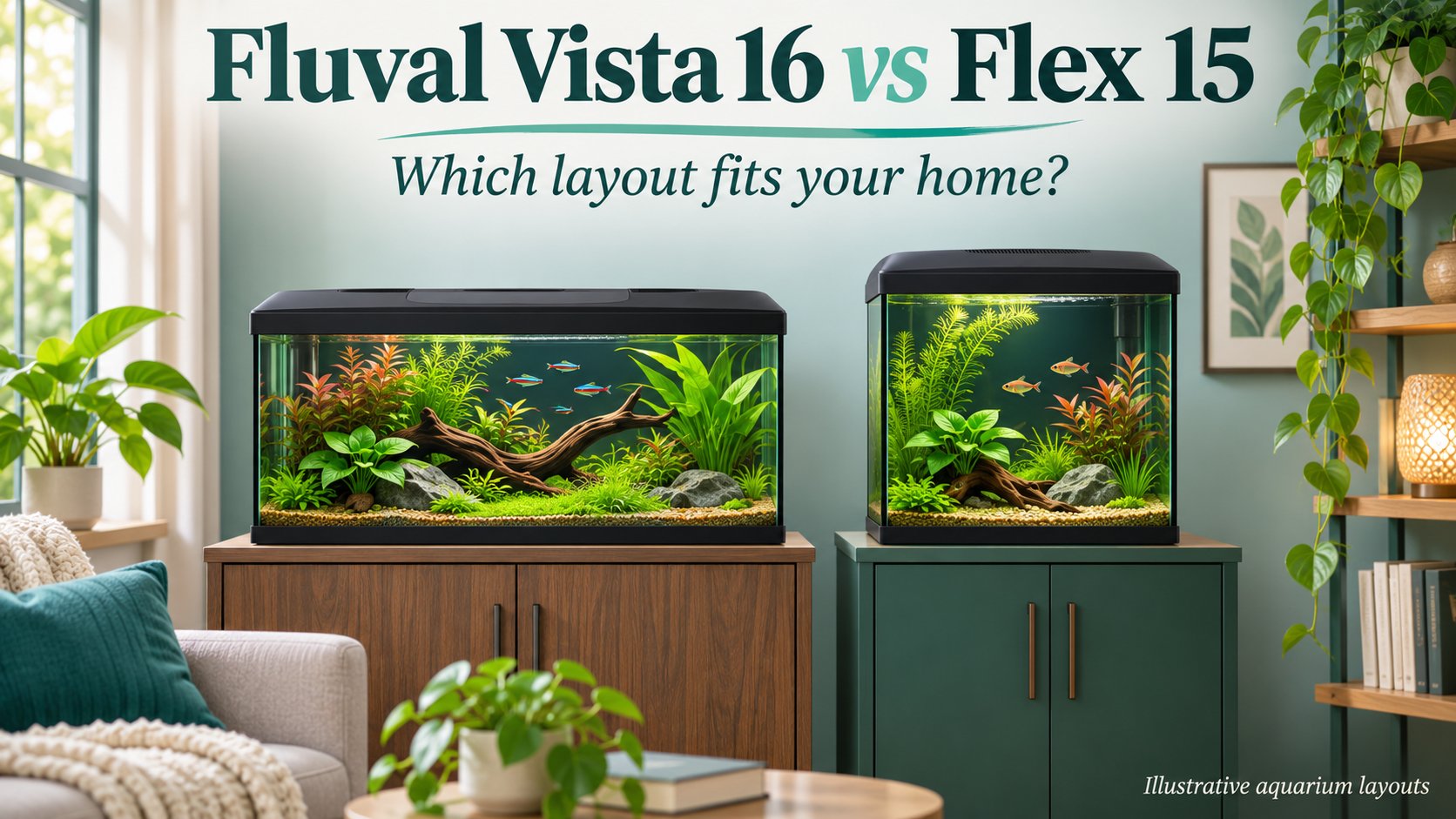
Comparing the Fluval Vista 16 vs Flex 15? These aquariums offer similar advertised capacities, but their layouts make them quite different to live with. The Vista provides a longer viewing area and an external filter; the Flex uses a compact footprint with filtration concealed behind the display.
This comparison uses manufacturer documentation, not hands-on testing. It covers the Vista 16, model 15245, and the original Flex 15, models 15006 and 15008. The newer Flex 2.0 is addressed separately below.
Fluval Vista 16 vs Flex 15: specifications
Fluval identifies model 15245 as the Vista 16 US gallon; its documents describe the metric capacity as 60 or 60.5 liters. Dimensions and lighting details appear in the Vista series manual. Original Flex specifications appear on Fluval’s Flex 9/15 page.
| Feature | Vista 16 | Original Flex 15 |
|---|---|---|
| Advertised capacity | 16 US gal / 60 L | 15 US gal / 57 L |
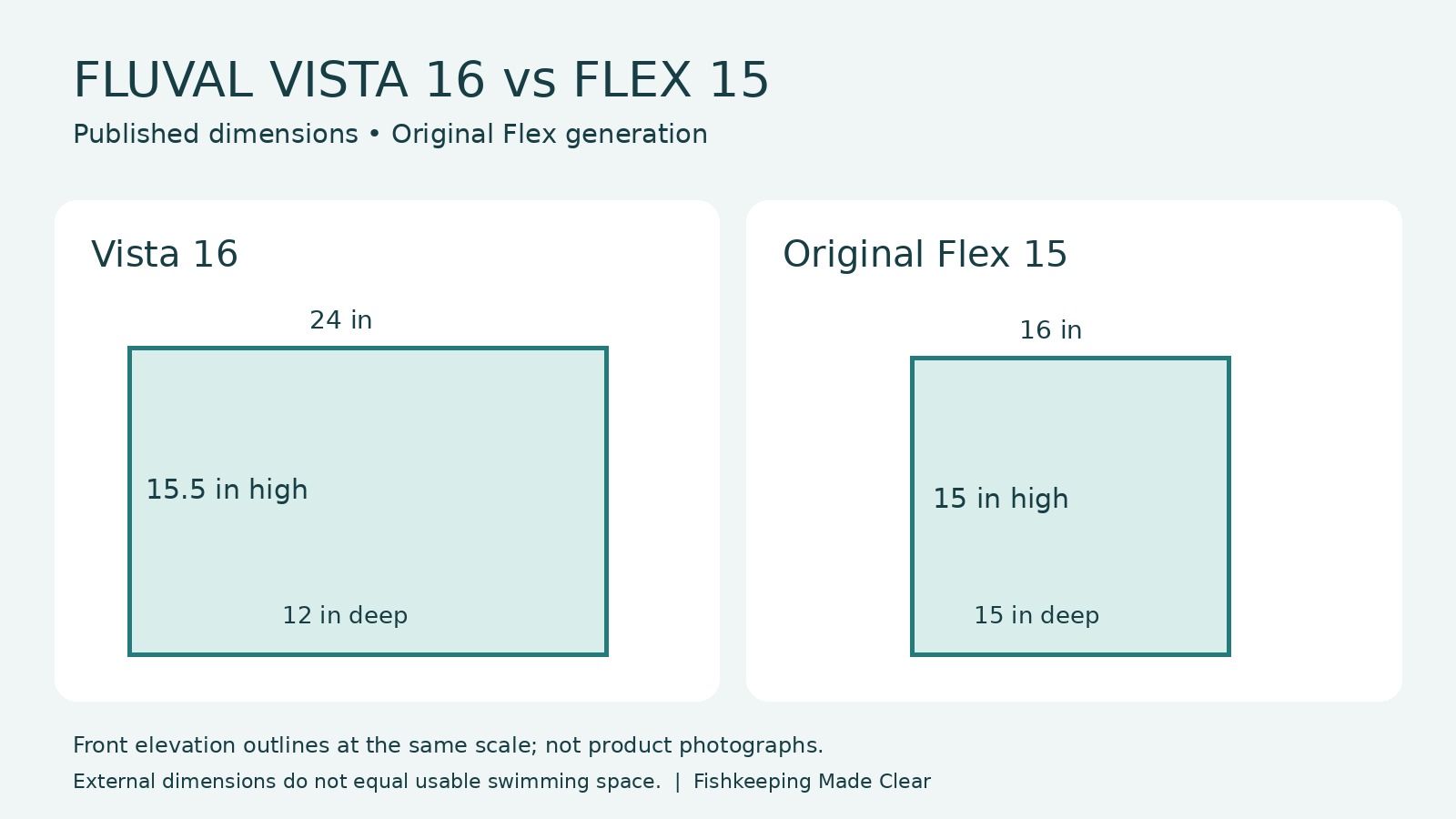
| Published dimensions, L × W × H | 24 × 12 × 15.5 inches | 16 × 15 × 15 inches |
| Design | Long panoramic bent-glass tank | Compact tank with curved front |
| Filter arrangement | AquaClear 30 hang-on-back filter | Integrated rear filtration compartment |
| Lighting | Soft-Start LED, 8000K | White and RGB LEDs, 7500K |
| Main placement consideration | More length plus clearance behind the filter | More front-to-back external depth; rear filter occupies internal space |
These are manufacturer-published dimensions, not measurements of the open swimming area. Confirm the exact unit and stand before buying, particularly with used equipment.
Which layout fits your home?
Vista: a longer horizontal display
The Vista’s 24-inch length gives it a noticeably wider front view than the Flex. That can suit a layout with plants, wood, and open space arranged along the tank’s length. Its bent-glass front corners provide a panoramic view with fewer visible front seams.
The practical trade-off is placement. The aquarium needs support for its full base, plus room behind it for the filter. A surface that just matches the glass dimensions may still leave inadequate clearance for equipment and servicing.
Flex: a compact display with concealed equipment
The Flex needs less left-to-right space, making it an option where the Vista’s length will not fit. Its curved front and hidden filtration give it a distinctive appearance without a filter housing hanging outside the rear wall.
However, its greater external front-to-back measurement does not prove that it offers more planting or swimming depth. The rear compartment uses part of that space. Plan your aquascape around the display section rather than treating every inch of the outer footprint as usable habitat.
For either aquarium, choose a level stand designed to support its filled weight and base. Leave working room above the lid and around electrical equipment. Furniture should be selected for structural suitability, not simply because the tank looks good on it.
Filtration and cleaning access
Fluval’s Vista 16 product listing identifies an AquaClear 30 hang-on-back filter. This is an external filter arrangement, not a built-in rear chamber. It leaves the display free of a full-width filtration partition, although the intake still occupies space inside the aquarium.
The original Flex uses rear filtration with foam, activated carbon, and biological media. Its pump is listed at 132 US gallons per hour. This is a published pump rating, not a promise of the exact flow through a stocked, decorated aquarium or a calculation of how many fish it can support.
The choice is mainly about access and appearance. With the Vista, you service a separate filter hanging behind the tank. With the Flex, you access components within the rear compartment. Before choosing, picture where your hands will go when removing media and reaching the pump.
Follow the appropriate equipment manual when cleaning, and disconnect electrical equipment as directed. Gently rinse reusable biological media in removed aquarium water when needed. Avoid replacing all established biological media at once; maintaining water quality depends partly on preserving those bacterial colonies.
Lighting: compare controls, not just numbers
The Vista includes Soft-Start lighting that gradually illuminates the aquarium. Its published color temperature is 8000K. For a straightforward freshwater display, that provides a simpler lighting approach than the Flex’s adjustable color effects.
The original Flex has 48 white LEDs and six RGB LEDs, with remote control for brightness, colors, and effects. Its 7500K color-temperature figure describes the appearance of its white light; it does not by itself establish superior plant growth.
The Vista can also support a planted layout. Fluval’s Vista guidance describes its lighting as suitable for low- to medium-light plants. Choose plants for the actual setup and manage lighting duration, nutrients, and maintenance together. Color effects are a viewing preference, not a substitute for meeting plant requirements.
What else should you budget for?
Compare the exact package contents with your setup needs before ordering extras. Buy only what is missing or unsuitable for your intended livestock, and check used kits for missing parts. Your complete setup should include:
- Suitable support: a properly sized aquarium stand.
- Temperature equipment: a heater if required by your species and room conditions and not already included, plus a thermometer if not supplied.
- Water preparation and testing: conditioner appropriate for your water supply and tests for ammonia, nitrite, nitrate, and pH.
- Habitat materials: suitable substrate, cover, and optional live plants.
- Maintenance supplies: a siphon, aquarium-only bucket, appropriate glass-cleaning tool, and net.
For a broader look at equipment bundles, see our freshwater aquarium starter-kit comparison.
Before adding fish, establish biological filtration using a documented cycling method. During fishless cycling, zero ammonia and nitrite readings in unused water do not prove readiness. The system must demonstrate that it can process an appropriate added ammonia dose; Dr. Tim’s cycling guidance explains that verification. Bottled bacteria and an ammonia source serve different purposes.
Pros and cons
Vista 16
- Advantages: longer horizontal layout, panoramic viewing, and a separate filter accessible behind the aquarium.
- Limitations: requires more length and rear clearance; filter equipment is less concealed.
Original Flex 15
- Advantages: compact width, hidden rear filtration, and remote-controlled lighting.
- Limitations: the rear chamber reduces display space; maintenance requires access within that compartment; replacement parts must match the generation.
For more detail on the original model, read our Fluval Flex 15 review. Neither aquarium’s capacity alone establishes suitability for a particular fish community.
How Flex 2.0 differs
The Flex 2.0 15-gallon model, item 15052, is a separate generation. Fluval lists 6500–7000K white and RGB lighting, a redesigned media stack with three foam blocks and three biological/chemical baskets, and an EZ-Lift handle.
It also includes changes to cover access and cable routing. Both generations include remote-controlled lighting. Fluval states that the newer covers are not compatible with first-generation tanks; check model numbers before buying replacement parts.
Fluval Vista 16 vs Flex 15: which should you choose?
Start with the available space and your planned livestock. The Vista offers the longer layout and an external filter; the original Flex offers compact width, concealed filtration, and more lighting controls. Choose the aquarium whose dimensions and equipment access suit your planned habitat, then budget for the remaining setup supplies before bringing fish home.